


MDF, Particle Board or Plywood: Specify Cabinets by Component
Specify cabinet boxes, backs, shelves and door fronts separately: compare substrates, finishes, thickness, edge treatment and project documentation.
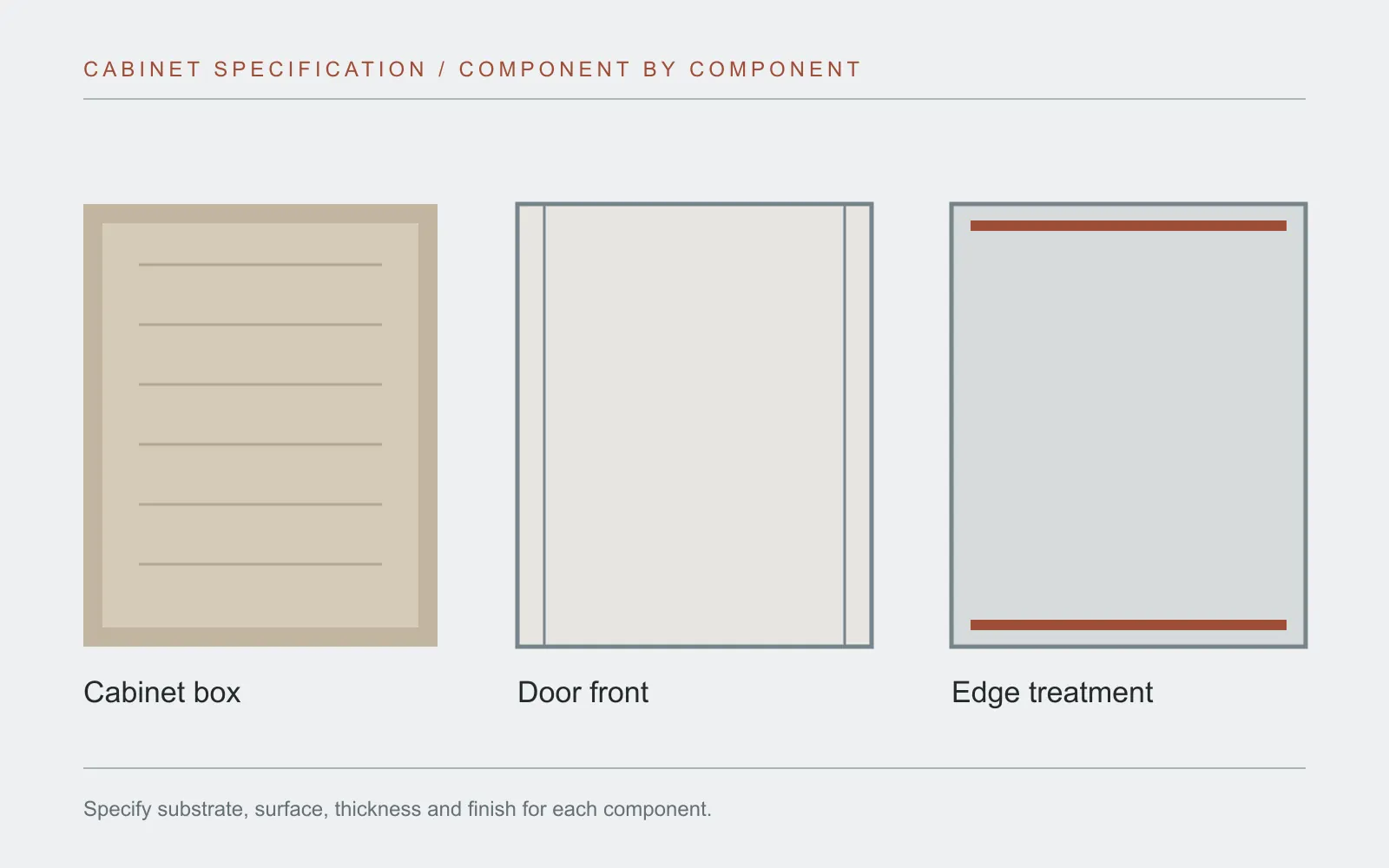
Choose cabinet boards by component and intended use, rather than asking for one material to cover the entire kitchen. A door face, a shelf and a cabinet box have different requirements. MDF, particle board and plywood describe material families; the exact grade, thickness, finish and construction still need to be specified.
Where each material enters the discussion
MDF is made from wood fibres and resin. Its uniform surface makes it a candidate for painted fronts and routed door designs. Confirm the specified grade and the finishing system for the intended room.
Particle board uses wood particles and adhesive. It is commonly considered for cabinet interiors and shelving, including melamine-faced components. Compare the complete specification, including the face finish and edge treatment, rather than the board name alone.
Plywood is built from bonded veneer layers. It can be considered for cabinet boxes and shelves where the design calls for it. The panel grade, thickness, joints and support arrangement remain part of the decision.
None of these names alone establishes a finished cabinet’s moisture resistance, emissions compliance or load capacity. Request documentation for the actual panel and intended application when those requirements are part of your project.
Particle board, plywood and MDF: a comparison for your brief
Use the material family to frame the next question, then compare the actual proposed panel. This table summarises selection questions; it does not rank every grade of one material above another or establish availability in every SNEJ range.
| Material family | Where it may enter the specification | What to compare in the supplier’s proposal |
|---|---|---|
| Particle board | Cabinet interiors, shelves and suitable front constructions | Panel identity and grade, thickness, face finish, edge treatment and support arrangement |
| Plywood | Cabinet boxes or shelves where the selected construction calls for it | Panel grade, thickness, face quality, joints, exposed-edge finish and supporting documents |
| MDF | Painted or routed fronts where compatible with the selected finish | Board grade, profile, thickness, coating system and treatment of faces and edges |
For a particle-board-versus-plywood comparison, keep the component dimensions, finish, hardware and intended use the same. Ask each supplier to identify the exact panel and any evidence required for the application. A material name or a different panel’s report is not enough to compare the finished cabinets.
What SNEJ’s material training identifies
SNEJ’s undated Whole-house Customisation Materials Introduction separates cabinet-box materials from door-front substrates. Page 4 identifies particle board for cabinet boards and some door fronts, and high-density fibreboard with a white base for some door fronts. This is a description of the training document’s material options, not a promise that every range uses the same board.
| Component being discussed | Material identified in the training document | Confirm for the quoted range |
|---|---|---|
| Cabinet box | Particle board | Board identity, thickness, face finish and exposed-edge treatment |
| Some door fronts | Particle board | Compatibility with the selected profile, finish and edge detail |
| Some door fronts | High-density fibreboard, white base | Exact substrate grade, thickness, machining and finish system |
Ask for a component-level material schedule. A cabinet box and its front can have a coordinated appearance while using different substrates. The selected finish alone does not tell you which board is underneath it.
Specify the component, not just the board family
| Component | Record before approving the quotation |
|---|---|
| Cabinet sides, top and bottom | Substrate, nominal thickness, face finish, exposed-edge treatment and jointing method |
| Back panel | Material, thickness, how it is fitted and whether its finish remains visible |
| Shelf | Material, thickness, span, support and intended contents |
| Door or drawer front | Profile, substrate, surface on both faces, edge treatment and hardware preparation |
SNEJ training material illustrates one whole-house cabinet configuration with an 18 mm cabinet board, 9 mm back panel and PUR edge-banding process. These numbers describe that configuration; they are not a blanket specification for every cabinet or wardrobe. Ask for the actual construction schedule for the range quoted to your project.
Why exposed edges need a specification
Cut cabinet panels leave edges that require a suitable finish where they remain exposed. Edge banding affects appearance and helps protect the panel edge during normal use, but the result depends on the panel, band material, adhesive, application and installation details together. For kitchens, ask which exposed edges receive banding, how corners and sink-adjacent panels are treated, and what happens at joints or cut-outs. PUR describes one adhesive process; it does not guarantee a particular moisture rating or service life for every cabinet. Request the proposed edge detail and any test evidence needed for the project’s conditions.
The training material also discusses rubberwood-core board and MDI adhesive. A board’s composition and its adhesive system are separate facts. A claim about no added formaldehyde in an adhesive must not be read as a claim that a finished panel releases none. If an emissions class or destination-country test matters, identify the particular panel, standard and report to be reviewed.
Read a board test report: an archived example
SNEJ’s material archive includes report 2024W0993, issued on 14 May 2024 by the Research Institute of Wood Industry, Chinese Academy of Forestry. The manufacturer and commissioning company named in the report is 辽宁尼尔科达环保材料有限公司. Use it as an example of how to read a board report and identify its scope.
| Report field | What this original records |
|---|---|
| Product and stated grade | Particle board for furniture in dry conditions; ENF grade |
| Board specification | 2440 × 1220 × 18 mm |
| Submitted test specimens | Five pieces, each 600 × 600 × 18 mm |
| Production date | April 2024 |
| Test period | 22 April–14 May 2024 |
| Scope statement | Results apply only to the submitted sample |
The full-board specification and the sizes of the submitted specimens are different fields. Neither is a finished cabinet’s dimensions. The report lists GB/T 39600-2021 for formaldehyde and LY/T 2870-2017 for the volatile-organic-compound items.
The selected results below cover formaldehyde emission and total volatile organic compounds (TVOC). Read the measured value, unit and reported limit together:
| Reading | Value stated in the report |
|---|---|
| Result | Formaldehyde emission: 0.025 mg/m³ |
| Limit | Formaldehyde emission: ≤0.025 mg/m³ |
| Result | TVOC: 0.05 mg/m³ |
| Limit | TVOC: ≤0.50 mg/m³ |
Both items are marked as passing in the original report. These are historical sample results, not results for every SNEJ cabinet, every board batch or an unspecified future order. They do not establish approval for an Australian or Canadian project; the specified components and applicable requirements must be reviewed separately.
View the complete original report (PDF, Chinese, 3 pages, 9.3 MB). The PDF is unchanged and includes the other tested items and the issuer’s scope statement.
Before accepting a report for your order, compare:
- Material identity: the manufacturer, product, grade and thickness against the proposed component schedule.
- Sample and date: what was tested, when it was produced and how it relates to the material proposed for your order.
- Test basis and units: the listed standard, measured result and limit for the property you actually require.
- Scope: a board result, a finished-product result and destination documentation answer different questions. Identify which evidence your specification calls for.
What to record before comparing quotations
Ask each supplier to identify:
- The material and thickness for the doors, cabinet sides, backs and shelves.
- The surface finish and edge treatment for each component.
- The hardware and fixing arrangement included in the design.
- Any project-specific documentation required for the destination market.
For a coordinated kitchen and wardrobe package, use the same schedule format for both product groups. The visible front may use a different construction from the cabinet box even if their colour references look alike.
First align what is included, then compare the prices.
Keep the finish decision connected to the board
A colour reference does not identify the material beneath it. Review the board and the visible surface together, and approve a physical sample for the selected finish.
See the cabinet finish selection guide and include the agreed material schedule in your kitchen quotation brief. SNEJ can discuss free samples, with shipping paid by the buyer, before you send the project enquiry.
Cabinet material questions before ordering
Does choosing a door finish also select the cabinet-box material?
No. Record the cabinet box and door front separately. The SNEJ training document lists different uses for particle board and fibreboard; a colour or finish name does not replace that component specification.
Is plywood the standard construction for every SNEJ cabinet?
The material reference reviewed here does not establish plywood as a universal SNEJ standard. If your brief calls for plywood, state the component, grade and thickness required, then confirm whether that construction is available for the selected range.
How should Australian and Canadian buyers compare material proposals?
Use the same component schedule for every proposal, and list the documentation required for your project. Keep substrate, face finish, edge treatment and hardware as separate fields. See the Australian cabinetry ordering checklist and the Canadian cabinetry planning guide for the next procurement steps.
Source note: SNEJ Whole-house Customisation Materials Introduction, undated training edition, page 4; reviewed on 16 October 2026. Material availability and the final bill of materials must be confirmed for the quoted range.